Kaizen works. Kanban works. Hoshin works. When they are embedded.
Many organizations adopt methods – and wonder why the impact never materializes. The failure does not lie in the tool. It lies in the leadership logic.




The Misconception
We tend to think of methods like Kaizen, Kanban, or Hoshin Kanri as “Japanese success recipes.” But this perspective falls short.
Toyota perfected these principles – no question. At the same time, the Toyota Production System did not emerge in a vacuum: Ohno studied Ford’s production logic intensively, Deming shaped quality thinking in Japan profoundly. TPS was not a copy, but a deliberate evolution – built on foundations that extend far beyond Japan. These methods were never exclusively Japanese. They were universal from the start.
And that is precisely the problem with how many organizations deploy them: They adopt the tools – Kanban boards, strategy workshops, improvement initiatives – but not the steering logic that gives them impact.
The energy is there. The will is there. And yet, remarkably little changes.
This is not a motivation problem. It is an integration problem.
Why Toyota Works – and Why Haier Works
If methods are universal, what makes the difference? The answer does not lie in the method, but in the consistency of the management system.
Two examples that could hardly be more different:
Toyota integrates through process stability. Clear standards, institutionalized learning routines, defined escalation mechanisms. Every employee may – and should – improve processes, but within clearly defined guardrails. The system is designed for incremental improvement, governed by discipline and repetition.
Haier, the Chinese multibillion-dollar corporation, takes a radically different path. With the Rendanheyi model, the company was restructured into thousands of micro-enterprises – small, autonomous units with direct market access and full accountability for results. Improvement here emerges less through standardized routines than through entrepreneurial pressure, customer proximity, and market-based steering mechanisms.
Two fundamentally different architectures. Yet they share one thing: They are internally consistent.
Strategy determines priority. Priority determines resources. Resources determine focus. Focus enables learning capacity.
A closed loop.
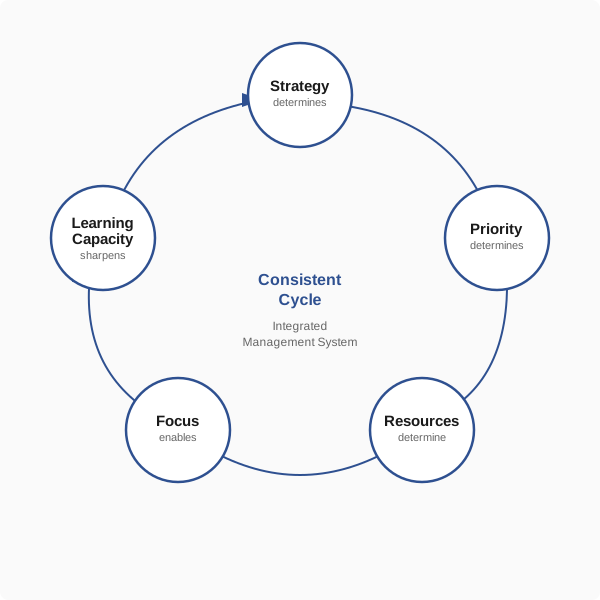
The consistent cycle: Strategy, priority, resources, focus, and learning capacity as an integrated system.
What Consistent Systems Have in Common
Behind this consistency lie three structural properties – regardless of whether a system is built like Toyota or like Haier:
Clear strategic prioritization. Strategy is not merely formulated, but operationalized. Resources follow priorities. Initiatives are actively terminated. Strategy is not a communication exercise, but a decision-making logic. Focus is not an appeal, but a decision.
End-to-end steering mechanics. Initiatives are bounded. Accountability is unambiguous. Decision rights are transparent. Flow is the result of discipline – not motivation.
Systemically connected improvement. Improvement influences prioritization. Learning changes resource allocation. Governance stabilizes direction. Improvement is part of the cycle – not a parallel project.
Mindset Needs Architecture
It is often argued that the decisive difference lies in mindset: embracing change as the norm, taking ownership, being willing to learn.
That is true – but incomplete.
Mindset without structure produces appeals. Structure without mindset produces bureaucracy.
Toyota resolves this tension through routines that make improvement a daily standard. Haier resolves it through market mechanisms that enforce ownership. In both cases, mindset is not a prerequisite of the system – it is its outcome.
Effectiveness emerges where both come together: in deliberately designed decision mechanics, prioritization processes, and accountability structures.
How to Recognize an Inconsistent System
The diagnosis is often uncomfortable, but unambiguous:
- Initiatives are rarely actively stopped.
- Strategic objectives have no explicit resource commitment.
- Portfolio decisions are political rather than structural.
- Improvement suggestions do not change priorities.
- Leadership talks about focus – while simultaneously increasing the number of topics.
This is not a culture problem. It is an architecture problem.
The Management Question
Steerability does not emerge from motivation. Not from workshops. Not from new tools.
It emerges when prioritization logic, decision rights, governance, and improvement are designed as an integrated system.
The decisive question is therefore not which method fits your culture. The decisive question is: Is our management system steerable as a whole?
Methods are universal. Consistent management systems are not. They do not emerge from adopting individual tools – but from deliberate management design.
And that is precisely where it is decided whether change is structurally possible – or merely rhetorically desired.